
Sermon Takeaway 10/25/2026

Can God Really Use Someone Like Me?
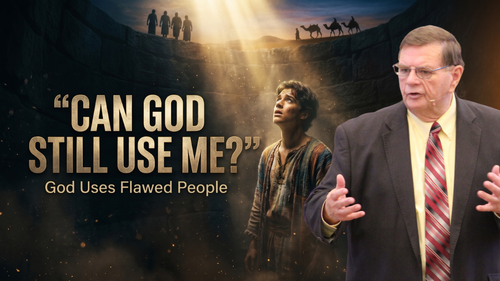
There is a question that quietly haunts many believers. It does not always announce itself loudly. Instead, it runs in the background of daily life like a persistent whisper, surfacing in moments of self-reflection or when the weight of past mistakes becomes too heavy to ignore. The question is this: Can God really use someone like me?
Most of us can look around and see people who appear gifted, steady, and spiritually confident. We watch them serve, teach, lead, and encourage others, and something inside us says, yes, God can clearly use them. But then we turn the lens inward. We know our own history. We know the decisions we are not proud of, the patterns we have struggled to break, the moments where we chose wrongly and hurt others or ourselves in the process. And suddenly the question becomes deeply personal. Can God use someone with this kind of story?
The answer, drawn from one of the most raw and honest narratives in all of Scripture, is a resounding yes.
A Family Far From Perfect
Genesis 37 presents us with a family that is, by any reasonable standard, a mess. Jacob, one of the great patriarchs of Israel, has twelve sons who will eventually become the twelve tribes of a nation through which God would bless the entire world. That sounds magnificent in summary. The reality, however, is far less polished.
These brothers hate one of their own. Their younger brother Joseph has received favor from their father, has dreamed dreams that suggest future prominence, and has become the target of a rage so deep that ten grown men conspire to kill him. They throw him into a dry cistern, a stone pit used to collect rainwater, and then, with stunning callousness, sit down to eat a meal while their brother cries out from the pit below.
When a caravan of Ishmaelite traders passes by, Judah, the very man from whose lineage the Messiah would one day come, suggests selling Joseph rather than killing him. Not out of compassion, but out of profit. Joseph is sold for twenty shekels of silver and hauled off toward Egypt as a slave.
To cover their tracks, the brothers slaughter a goat, dip Joseph's distinctive coat in the blood, and bring it to their father Jacob. Jacob, who had himself once deceived his own father using a slaughtered goat, now becomes the victim of the same kind of deception. He collapses in grief, convinced his beloved son is dead.
This is the family God chose to build a nation. These are the men whose names would be carried through thousands of years of history, whose descendants would be sealed and counted in the final pages of Revelation. If you were selecting candidates for divine use, you would not have started here.
Two Realities Running at Once
Understanding what God is doing in this story requires grasping two truths that operate simultaneously throughout Scripture and throughout your own life.
The first is the providence of God. Providence is the reality that God cares for His people as they move through life, making real choices with real consequences. These brothers made terrible choices. Jacob made choices that planted seeds of favoritism and dysfunction in his household. Joseph would soon face circumstances entirely outside his control. All of it happened within the real world of human decision and human failure. God does not override that world. He works within it, even through the darkest parts of it.
The second is the sovereignty of God. Above and through every human decision, God has a plan that cannot be stopped. His sovereign purpose was to provide redemption for humanity, and He was working that plan through this broken family, through this betrayal, through this pit, through this slave caravan heading into Egypt. None of it caught God off guard. None of it derailed His purposes. In fact, God was using every painful, ugly chapter of this story to position Joseph exactly where He needed him to be.
The same two realities are at work in your life right now.
What God Is Actually Looking For
Here is what this story makes unmistakably clear: God is not waiting for perfect people. There are none. Every person in this narrative is flawed. The brothers are cruel and dishonest. Jacob is a man whose own history includes deception and manipulation. Even Joseph, who stands as the most admirable figure in the story, is not without his own imperfections.
God works with flawed people because that is the only kind of people there are.
Romans 3:23 reminds us that all have fallen short of the glory of God. But that verse exists in a larger context of grace, one that stretches from Genesis to Revelation, showing again and again that God takes broken, unlikely, deeply imperfect people and uses them to accomplish things that outlast their lifetimes.
The brothers who sold Joseph into slavery would one day become the fathers of a nation. Judah, who suggested profiting from his brother's misery, would carry the lineage of the Savior of the world. What looks like disqualification is not the end of the story when God is the author.
The Question That Remains
So yes, God can use you. That question has been answered. The more pressing question is whether you are allowing Him to.
There is a difference between believing God can use someone and actually making yourself available to be used. Availability looks like stepping into service even when you feel unqualified. It looks like using whatever gift or ability you have, however small it seems, in the work of the kingdom. It looks like refusing to let your past write the final word on your future usefulness.
There is a difference between believing God can use someone and actually making yourself available to be used. Availability looks like stepping into service even when you feel unqualified. It looks like using whatever gift or ability you have, however small it seems, in the work of the kingdom. It looks like refusing to let your past write the final word on your future usefulness.
When you step into service, something remarkable happens. You begin to experience the joy that comes not from watching others serve, but from being part of the work yourself. And perhaps more importantly, someone who knows your history watches you step forward and thinks, if God can use that person, maybe He can use me too.
Your story, including the painful parts, may be exactly what someone else needs to see. Do not keep it hidden. Offer it to God, and watch what He does with it.
Your story, including the painful parts, may be exactly what someone else needs to see. Do not keep it hidden. Offer it to God, and watch what He does with it.
Watch the full sermon here:
Recent Takeaways
Archive
2026
January
2025
March
September
October
November
No Comments