
Sermon Takeaway 11/01/2026

When God Works Through Broken Lives: The Hidden Message of Genesis 38
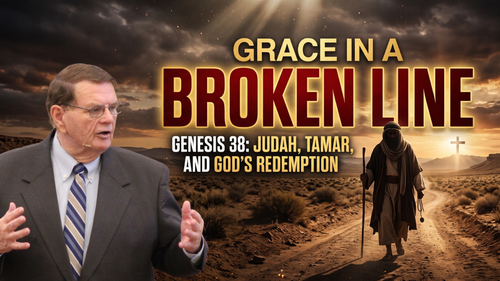
There is a chapter in the Bible that makes many readers uncomfortable. Tucked between the dramatic account of Joseph being sold into slavery and his subsequent life in Egypt, Genesis 38 seems to interrupt the narrative with a story so morally tangled that one might wonder why it belongs in scripture at all. But that discomfort is precisely the point. Genesis 38 is not an interruption. It is the message.
The Story We Would Rather Skip
Judah, one of the sons of Jacob, decides to leave his family and strike out on his own. He befriends a Canaanite man, marries a Canaanite woman outside of God's design for his family line, and raises three sons. The eldest, Er, is described as wicked, and God takes his life. The second son, Onan, refuses to fulfill his duty to his widowed sister-in-law Tamar and meets the same end. Judah promises Tamar that his youngest son, Shelah, will eventually marry her, but he never intends to keep that promise.
Time passes. Judah's own wife dies. Tamar, still waiting, still wearing her widow's garments, realizes she has been deceived. She takes matters into her own hands in a way that shocks the modern reader just as it would have shocked the ancient one. She disguises herself, positions herself along the road Judah will travel, and he mistakes her for a shrine prostitute. He takes her as such, leaving his signet ring, cord, and staff as a pledge of payment. Three months later, when word reaches Judah that Tamar is pregnant, he erupts in righteous indignation and demands she be punished.
Then she produces his signet, his cord, and his staff.
In that moment, Judah is forced to confront a truth that self-righteous anger had allowed him to avoid: she is more righteous than he is. He had withheld from her what was promised. He had failed in his responsibility. He had sinned and then pointed his finger at someone else's sin to avoid looking at his own.
The Mirror We Do Not Want to Hold Up
That pattern is painfully familiar. It is far easier to catalog the failures of others than to sit quietly with our own. Judah's outrage at Tamar's pregnancy is the outrage of a man who has not yet fully reckoned with who he is. And yet, remarkably, this is the man through whose line the Messiah will come.
That is not a minor detail. It is the entire point.
The Bible is not simply a collection of moral stories designed to give us heroes to imitate. It is the unfolding revelation of how God redeems a broken humanity. And the fact that God chose to bring salvation through the line of Judah, with all of his failures on full display, is a declaration that redemption is not earned. It is given. Salvation does not flow through the righteous. It flows through the grace of God toward the unrighteous.
The Sovereignty That Cannot Be Stopped
Tamar gives birth to twins. As the first child begins to emerge, the midwife ties a scarlet thread around his wrist to mark him as the firstborn. But he draws back, and his brother is born first. The child who was marked first comes second. His brother is named Perez, meaning breach, because he broke through unexpectedly.
This is not a coincidence. Throughout Genesis, God repeatedly works through the younger, the unexpected, the overlooked. The second supplants the first. The sovereign plan of God moves forward not through the most obvious candidate but through the one no one would have chosen.
Follow the line of Perez forward through scripture and you arrive at the genealogy in the book of Ruth, where Perez begins a lineage that leads to King David. Open the first chapter of Matthew and that same line continues, stretching from Abraham through Judah, through Perez, through David, all the way to Jesus Christ. Tamar's name appears there. Her son's name appears there. The sordid details of Genesis 38 are not buried or forgotten. They are woven into the very introduction of the gospel.
God did not work around the mess. He worked through it.
What This Means for Us
There are two truths held in tension throughout this story, and both demand our attention.
The first is that our choices matter. Judah's decisions had consequences. His sons bore the weight of a family shaped by deception and dysfunction. The pattern Jacob established in his own home rippled outward into his children's lives. What we do, how we live, the integrity or lack thereof that we model before those who look to us, none of it is inconsequential. God does not simply wave away the effects of our sin as though they never happened.
The second truth is that God's plan cannot be undone by human failure. The sovereign God was at work in the middle of every bad decision, every broken promise, every act of self-serving cowardice in Genesis 38. He was working to ensure that the Messiah would come, that redemption would be made available, that the promise made to Abraham would be kept.
These two truths together produce something remarkable: urgency and hope at the same time. The urgency of understanding that how we live matters, and the hope of knowing that even our worst chapters do not place us beyond the reach of a God who redeems.
The Invitation
The New Testament describes two future judgments. One for those who have placed their faith in Christ, where sins are covered by his blood. One for those who have not, where the full record stands open. Every person will stand at one or the other.
Genesis 38 exists in scripture partly to remind us that no one arrives at grace through their own goodness. Judah did not. Neither do we. The same God who worked through a broken man in an ancient story is the God who offers, to anyone who will receive it, the covering of Christ's righteousness in place of our own record.
The choice, as it has always been, belongs to us.
The choice, as it has always been, belongs to us.
Watch the full sermon here:
Recent Takeaways
Archive
2026
January
November
2025
March
September
October
November
No Comments