
Sermon Takeaway 11/08/2026

Faithful in Every Season: The Life of Joseph and the God Who Never Leaves
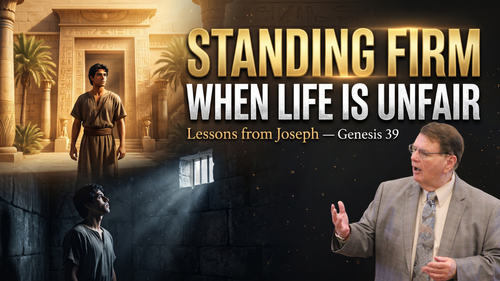
There is a question that follows every person of faith through the seasons of life, through promotions and prison cells, through abundance and humiliation, through the heights of success and the depths of undeserved suffering. The question is simple but searingly honest: Can you trust God right now, in this moment, wherever you find yourself?
The life of Joseph, recorded in Genesis 39, offers one of the most compelling answers to that question in all of Scripture.
The life of Joseph, recorded in Genesis 39, offers one of the most compelling answers to that question in all of Scripture.
The Man on the Auction Block
When we first encounter Joseph in this passage, he is not standing in a place of honor. He is standing on a slave auction block in a foreign country, stripped of dignity, inspected like livestock, purchased by a man named Potiphar. He is seventeen years old, far from home, betrayed by his own brothers, and wearing chains described in Psalm 105 as binding both his feet and his neck.
By every measure the world uses to assess a person's prospects, Joseph had none.
He was a Hebrew in Egypt, and Egyptians despised Hebrew herdsmen. He had no wealth, no connections, no leverage, and no freedom. He had every excuse available to a person who wants to give up, coast through life with minimal effort, or spend his days nursing bitterness toward the brothers who sold him and the God who seemed to have forgotten him.
He did none of those things.
Instead, Joseph went to work.
The Testimony That Cannot Be Faked
What happens next in Genesis 39 is quietly extraordinary. Joseph begins doing whatever task is placed in front of him with such consistent excellence that it gets noticed. Not just noticed by a supervisor, but noticed all the way up the chain until Potiphar himself is paying attention to this Hebrew slave.
Genesis 39:3 records something remarkable: Potiphar saw that the Lord was with Joseph.
Potiphar was an Egyptian. He did not worship the God of Israel. And yet something about the way Joseph worked, the way he carried himself, the integrity with which he handled every responsibility, made it undeniable that a divine hand was at work in this young man's life. The blessing was visible. The difference was real.
This raises a pointed question for anyone who claims faith: When people watch you go about your daily life, do they see you, or do they see something beyond you? Does the way you work, the way you treat people, the way you respond to difficulty point toward something greater than personal ambition or natural talent?
Joseph's life was a living sermon to everyone around him, and he preached it without saying a word about his faith. He simply lived it, day after day, with excellence and integrity, until Potiphar handed him the keys to everything.
The Pressure That Reveals What Is Inside
But the story does not stay comfortable for long. Joseph was, by the account of Genesis 39, a physically striking young man. And Potiphar's wife noticed. She approached him with a direct and shameless proposition, and Joseph refused.
She did not stop. Day after day, she returned with the same invitation, and day after day, Joseph refused.
His reasoning, recorded in Genesis 39:8-9, is worth sitting with. He did not refuse simply because it was against the rules. He did not refuse because he feared getting caught. He refused because he understood that this act would be a wickedness against God. His moral framework was not built on consequences. It was built on his relationship with the God he served.
This is the distinction that separates a life governed by spiritual principle from a life governed by emotion and desire. Judah, whose story appears in Genesis 38 just before this passage, represents the latter. When his flesh wanted something, he pursued it without restraint, and the consequences were devastating and far-reaching. Joseph represents something entirely different. He had the same human desires, the same emotions, the same capacity for temptation. He was a young man in the fullness of his strength, being pursued by a woman of status and beauty. And yet he held the line.
Because integrity is not the absence of temptation. Integrity is the decision made in the middle of it.
When Potiphar's wife finally grabbed him by his garment, Joseph did not negotiate. He did not linger at the edge of the line to see how close he could get. He ran. This mirrors the counsel found in 2 Timothy 2:22, which calls believers to flee youthful lusts rather than manage them from a comfortable distance. The wisest response to certain temptations is not resistance. It is retreat.
When Doing Right Leads to Prison
Here is where the story becomes most difficult, and most honest.
Joseph ran. Joseph did everything right. And Joseph ended up in prison.
Potiphar's wife lied. She fabricated an assault, wept convincing tears, and presented Joseph's own garment as evidence against him. And Potiphar, whatever doubts he may have privately held, had Joseph thrown into the king's prison, a place reserved for those awaiting execution.
From the outside, this looks like the story of a man abandoned by the God he served faithfully. From the inside, it is something else entirely. It is the story of a man being prepared for something he cannot yet see.
The path to Joseph becoming second in command over all of Egypt ran directly through Potiphar's house and directly through that prison. The education, the experience, the refinement of character that would be required for that role could not have been acquired any other way.
Romans 8:28 reminds us that all things work together for good to those who love God and are called according to His purpose. Not some things. Not the pleasant things. All things.
The Question for Every Season
The life of Joseph confronts every reader with the same searching question: Can you trust God in the good times without letting success become your god? And can you trust Him in the hard times without letting suffering become your identity?
Both are genuine dangers. Success tempts a person to forget the source of every blessing. Suffering tempts a person to conclude that God has either forgotten them or turned against them.
Joseph refused both traps. He served faithfully when things were going well, and he held to his integrity when everything fell apart. He did not know the end of the story. He simply knew the God who held it.
That is the invitation of this passage. Not to have all the answers. Not to understand every season of difficulty. But to trust the One who does, and to keep showing up with faithfulness, wherever you have been placed, until the full story becomes clear.
Watch the full sermon here:
Recent Takeaways
Archive
2026
January
2025
March
September
October
November
No Comments